Can time travel backwards
Some experiments appear to suggest that time may not be as straightforward as we usually imagine. In certain interpretations of quantum physics, the future seems to influence how we understand the past, or at least challenges the simple idea that cause and effect always move in one obvious direction. This does not necessarily mean the future literally changes the past, but it does suggest that time may be stranger than everyday experience tells us.
Another way to imagine time moving backwards, even at our own scale, is to begin with Einstein’s famous thought experiment involving a tram travelling away from a clock in Bern, Switzerland.
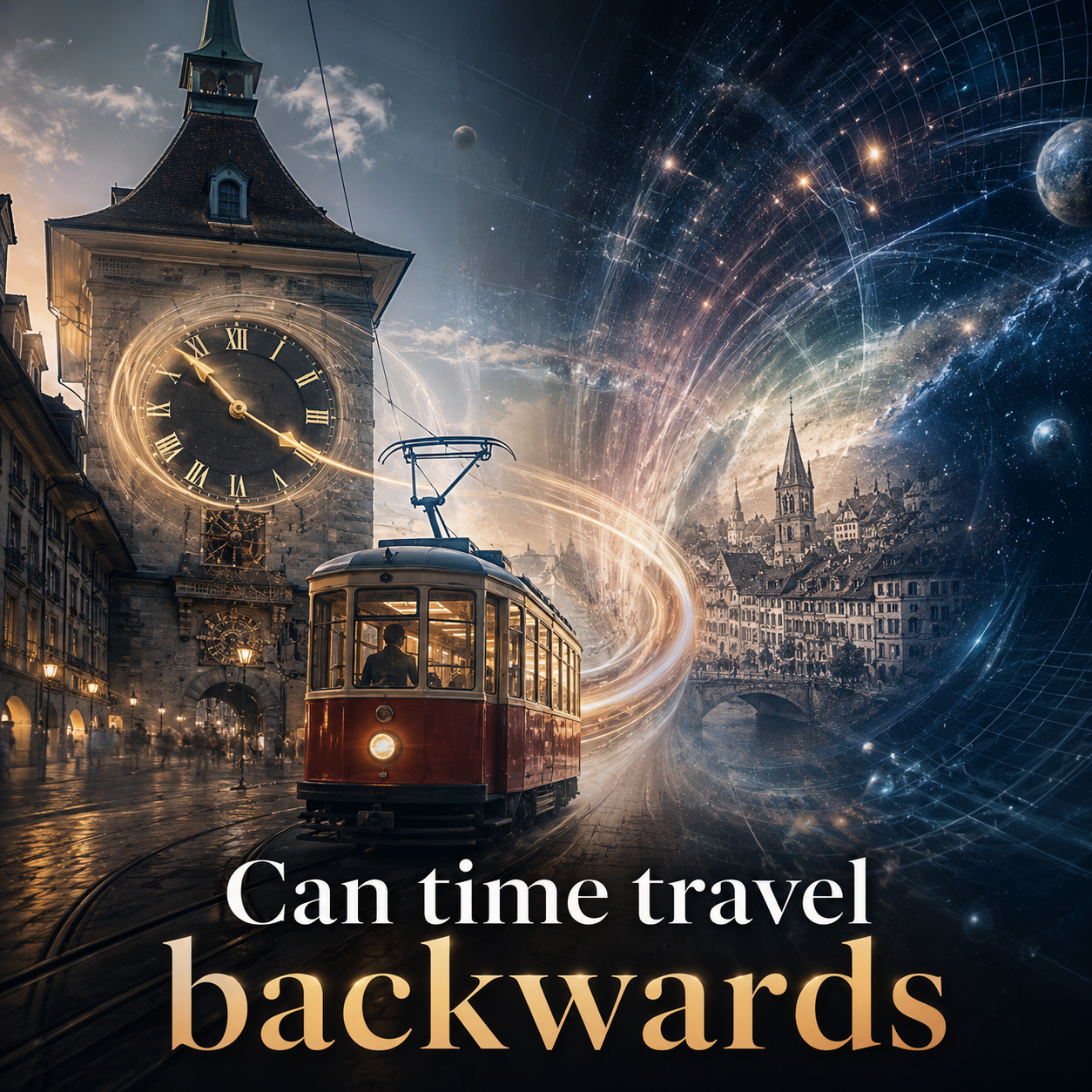 Einstein imagined travelling away from the Bern Clock Tower while watching its hands. As the tram increased its speed and approached the speed of light, the light from the clock would take longer and longer to reach him. From his point of view, the hands would appear to slow down. If he could somehow reach the speed of light, the clock would appear frozen in time.
But what if the tram could travel faster than light?
In that case, we would begin catching up with light that had left the clock before our journey began. The hands of the clock would appear to move backwards. The faster we travelled, the further back in time we would seem to look. Eventually, the clock itself would disappear, because we would be overtaking light from before the clock was built. If we continued, we might see light from before Earth existed, then from the early universe itself. Eventually, we would reach a point before the first stars had lit the cosmos, where visible light would fade into darkness.
However, if we could detect other forms of radiation or waves from that earlier period and convert them into visible images, we might continue our journey deeper towards the beginning of the universe. Yet even then, we may not be able to view the singularity itself. To see that, we would somehow have to step outside the universe altogether. If such a thing were possible, perhaps the beginning of our universe could only be seen from beyond it, from some greater multiverse containing our universe and many others.
But could time itself actually travel backwards?
Imagine that, while travelling faster than light but still within the universe, we began to slow down. At first, we would still be looking further into the past, but our movement through that backwards view would begin to slow. As our speed dropped below the speed of light, we would no longer be overtaking older light in the same way. From our point of view, the outside clock would gradually begin to move forward again.
Inside the tram, everyone would remain in sync with one another. Their own time would feel normal. But outside the tram, the clock would appear to change direction. As we slowed down, it would begin moving forward again, and its apparent speed would increase as our motion returned to ordinary speeds.
Of course, this is either impossible or close to impossible for any physical object. According to relativity, as an object with mass approaches the speed of light, the energy required to accelerate it increases without limit. Reaching or exceeding light speed is therefore not possible for ordinary matter.
It is also important to be careful with the idea of using data or information instead. Under accepted physics, information itself cannot be sent faster than light, so it does not provide a simple escape from the limit. That said, I am cautious about using the word impossible in an absolute sense. Quantum effects, spacetime, and the nature of information may still hold surprises. Perhaps time cannot truly run backwards in the way imagined here, but as a thought experiment, faster-than-light motion shows how easily our ordinary sense of past, present, and future begins to break down.


